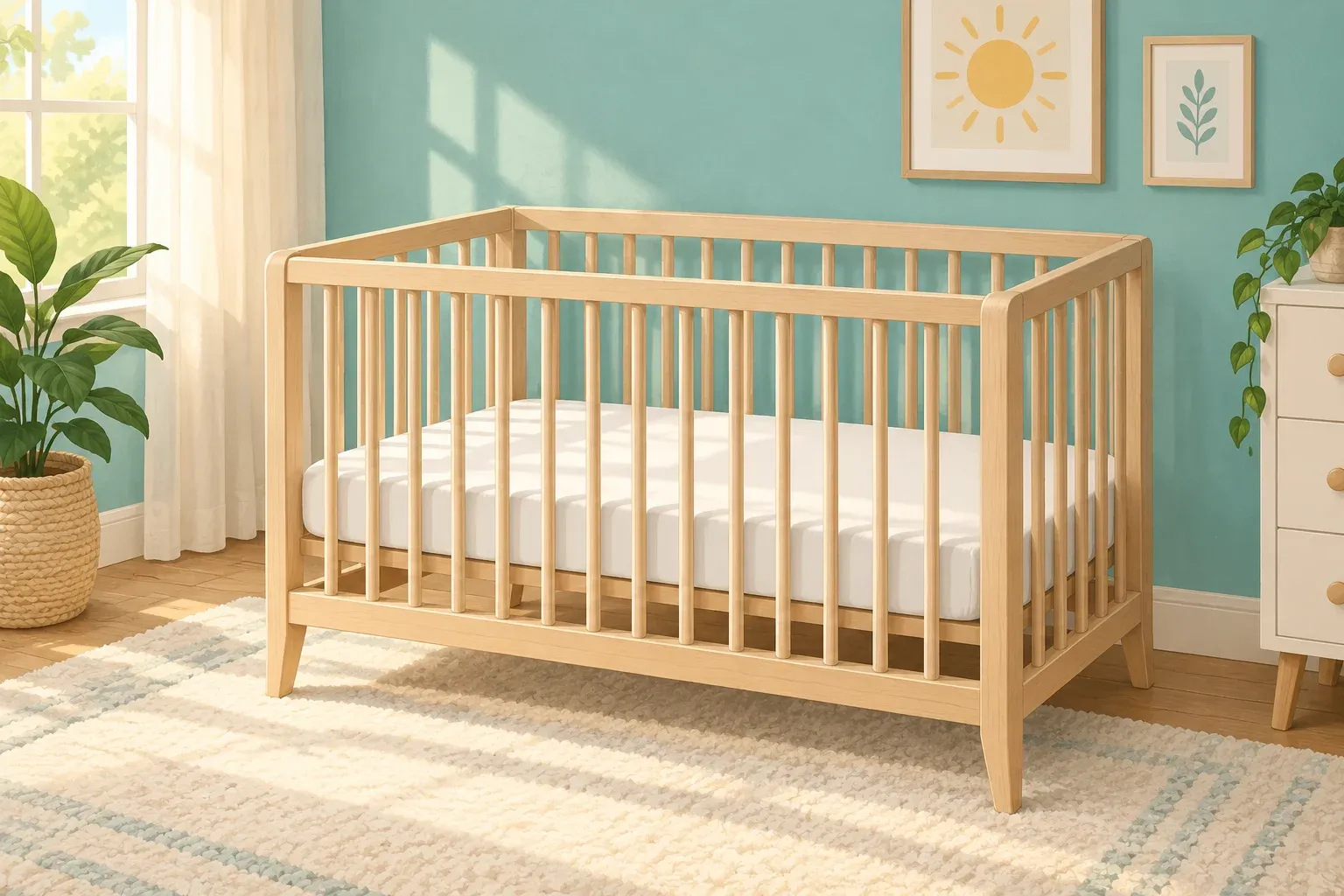
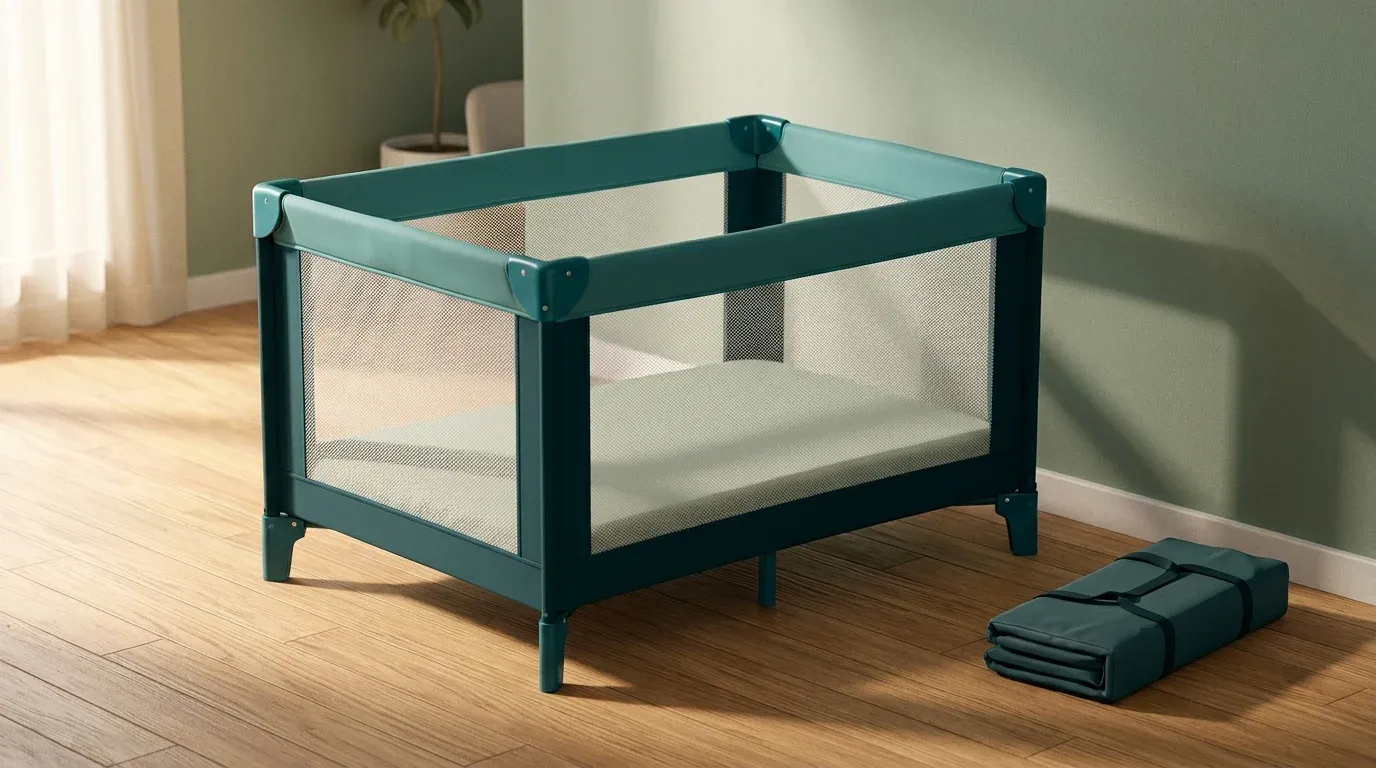
A crib, a bassinet and a play yard can all be safe places for a baby to sleep. They differ in size, how long they last and where they fit. Here’s how they compare, the federal rules behind each, and which suits your home.
If you already know you want a play yard, see our pack and play guide. For the full picture on sleep safety, read safe sleep for babies.
Crib vs bassinet vs play yard at a glance
| Crib | Bassinet | Play yard | |
|---|---|---|---|
| What it is | A rigid-sided bed for an infant. A full-size crib has an interior of about 28 by 52 3/8 in. | A small bed for young infants, with a sleep surface sloped no more than 10 degrees | A framed enclosure with a floor and mesh or fabric sides, for sleep and play. Many fold. |
| Child limits | Until your child moves to a bed. Follow the crib’s instructions. | About 5 months, or once your baby can push up on hands and knees, or the label’s weight limit, whichever comes first | Under 35 in tall and not able to climb out |
| Federal standard | 16 CFR 1219 (full-size) or 1220 (non-full-size) | 16 CFR 1218 | 16 CFR 1221, plus 1218 for a bassinet attachment |
| Portability | Stays put | Light enough to move between rooms; some fold | Folds for storage and travel |
| How long it lasts | Longest of the three | A few months | Until about 35 in or climbing out |
| Good for | A main bed from birth into the toddler years | Room-sharing in the early months, especially in a small bedroom | Travel, a second home base, or a main bed when space or budget is tight |
The federal safety standards
Every crib, bassinet and play yard sold in the US must meet a mandatory federal standard, set out in the Code of Federal Regulations (CFR).
- Full-size cribs: 16 CFR 1219. A full-size crib has an interior of 28 ± 5/8 in by 52 3/8 ± 5/8 in.
- Non-full-size cribs: 16 CFR 1220. This covers cribs outside full-size dimensions, including portable cribs that fold without taking them apart.
- Bassinets and cradles: 16 CFR 1218. Bassinet attachments for play yards and non-full-size cribs count as bassinets.
- Play yards: 16 CFR 1221. A play yard with a bassinet attachment must meet both the play yard and the bassinet requirements.
- Bedside sleepers: 16 CFR 1222. A bedside sleeper is secured to an adult bed. Its standard draws on the bassinet standard.
- Crib mattresses: 16 CFR 1241. Crib mattresses made after August 15, 2022 must meet this standard, and an updated version applies to mattresses made after May 3, 2026. It covers full-size crib mattresses, mattresses supplied with non-full-size cribs, and aftermarket mattresses for play yards and non-full-size cribs. It includes a test for gaps at the crib’s corners.
Two more mattress rules matter at home. CPSC says a full-size crib mattress must be no more than 6 in thick. An aftermarket mattress for a play yard or non-full-size crib must be at least the same size as the original, and a generic “fits most” size claim can’t meet the requirements.
Used and older cribs
Full-size cribs made before June 28, 2011 predate the current federal crib rules. CPSC tells resellers to destroy them unless there’s written proof they comply. If you’re offered an older crib, it’s safer to pass. For any secondhand sleep product, check for recalls using the model number on its label.
When to move from a bassinet to a crib
CPSC says a bassinet isn’t meant for a baby older than about 5 months, or for one who can push up on hands and knees. Your bassinet’s label also lists a weight limit. Move your baby to a crib or a play yard when they reach the first of these. Some labels add other stop points, such as rolling over, so read yours and follow it.
The same applies to a bassinet attachment on a play yard: stop using it at its label limit, then use the main play yard floor.
Safe sleep in any of the three
Current guidance from the AAP, CPSC and the NIH’s Safe to Sleep campaign comes down to a few habits:
- Room-share without bed-sharing. The AAP recommends your baby sleep in your room on a separate surface, ideally for at least the first 6 months. A crib, bassinet or play yard all work.
- Firm, flat and level. NIH describes a firm surface as one that springs back quickly when pressed, and a flat one as “like a table, not a hammock.”
- Bare is best. Use only a fitted sheet. Keep pillows, blankets, bumpers and toys out.
- No inclined sleepers. CPSC says inclined products with an angle over 10 degrees should never be used for infant sleep. Since November 12, 2022, the Safe Sleep for Babies Act has banned the sale of inclined infant sleepers and padded crib bumpers in the US. The ban also covers vinyl bumper guards and slat covers, but not non-padded mesh liners.
- Use the mattress made for it. Don’t add a second mattress, a topper or a thicker pad to a play yard or bassinet. Ill-fitting aftermarket play yard mattresses have been recalled for entrapment risk; our pack and play guide has the details.
Which should you buy?
You don’t need all three. One main bed is enough for many families.
For a small home
A bassinet takes the least floor space for room-sharing in the early months, but it only lasts a few months. A play yard with a bassinet attachment gives you a raised newborn level now and a bigger sleep space later, in one frame. If a crib fits beside your bed, you can use it from birth and skip the bassinet.
For travel or two homes
A play yard is the obvious pick because it folds. If you travel often, it can be your only second bed. Use the mattress or pad it came with, at grandparents’ houses and hotels too.
On a budget
A crib used from birth lasts the longest of the three, so it usually gives you the most use if you have space. A play yard can serve as your baby’s main bed and doubles as a travel bed, but your child outgrows it at 35 in or once they can climb out. A bassinet is a convenience, not a necessity, because it lasts only a few months.
Whatever you choose, look for a product sold as a crib, bassinet or play yard in the US, so it has to meet the federal standard. Our recall guide explains how to register it and check for recalls. Browse more in our Nursery & Sleep guides.
Frequently asked questions
Do I need a bassinet?
No. NIH’s Safe to Sleep campaign lists a crib, bassinet or portable play yard as a safe separate sleep space. A bassinet is handy for room-sharing in a small bedroom, but a crib or play yard can be used from birth.
Can my baby sleep in a play yard every night?
Yes, if it meets the federal play yard standard and you use only its own mattress with a fitted sheet. Your child outgrows it at 35 in tall or once they can climb out.
When should my baby move out of the bassinet?
At the first of these: the label’s weight limit, about 5 months, or when your baby can push up on hands and knees. Follow any other stop points on your label.
Can I put a thicker mattress in a play yard?
No. Use the mattress that came with it, or a replacement made for your exact model. CPSC requires aftermarket play yard mattresses to be at least the size of the original, and a generic size claim doesn’t qualify.
Is a bedside sleeper the same as a bassinet?
Not quite. A bedside sleeper is secured to the side of an adult bed and has its own federal standard, 16 CFR 1222. Your baby still sleeps on a separate surface, so the same safe sleep rules apply.