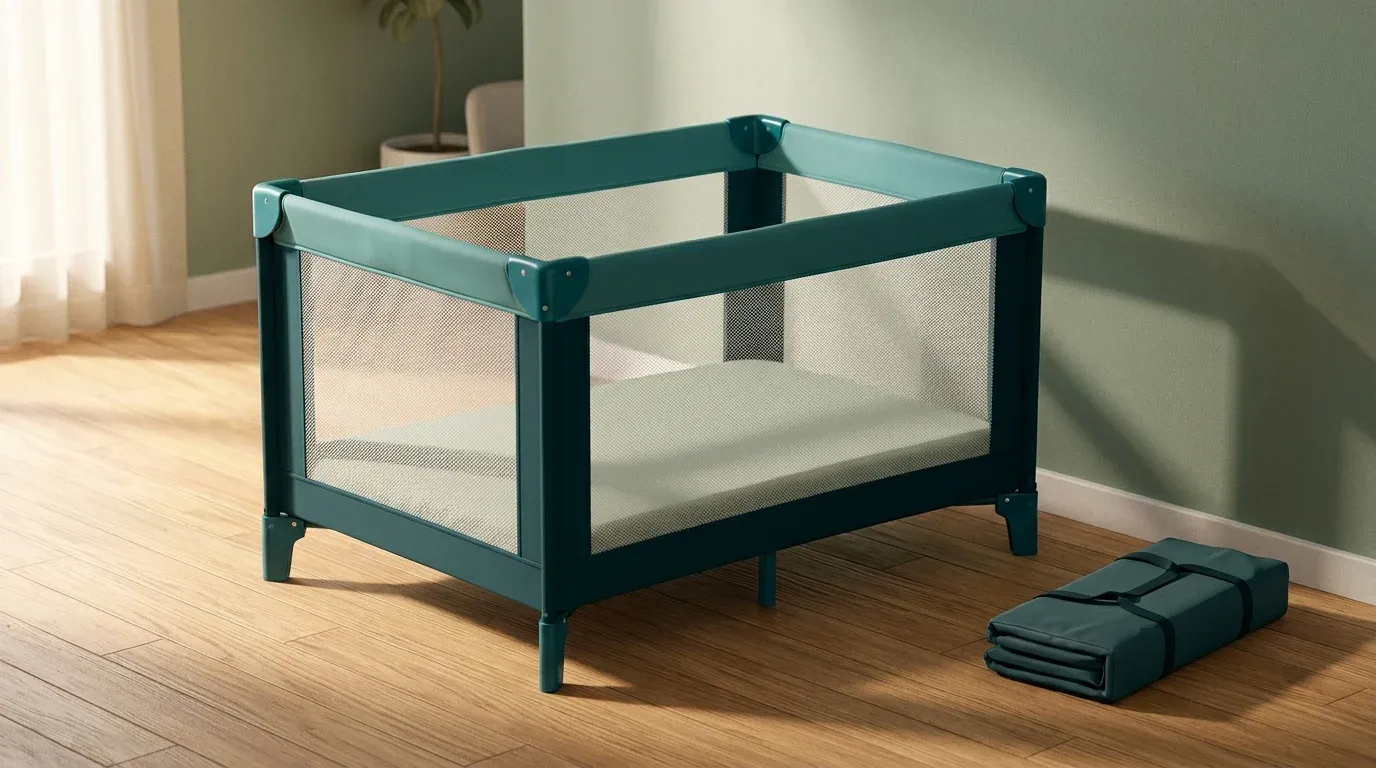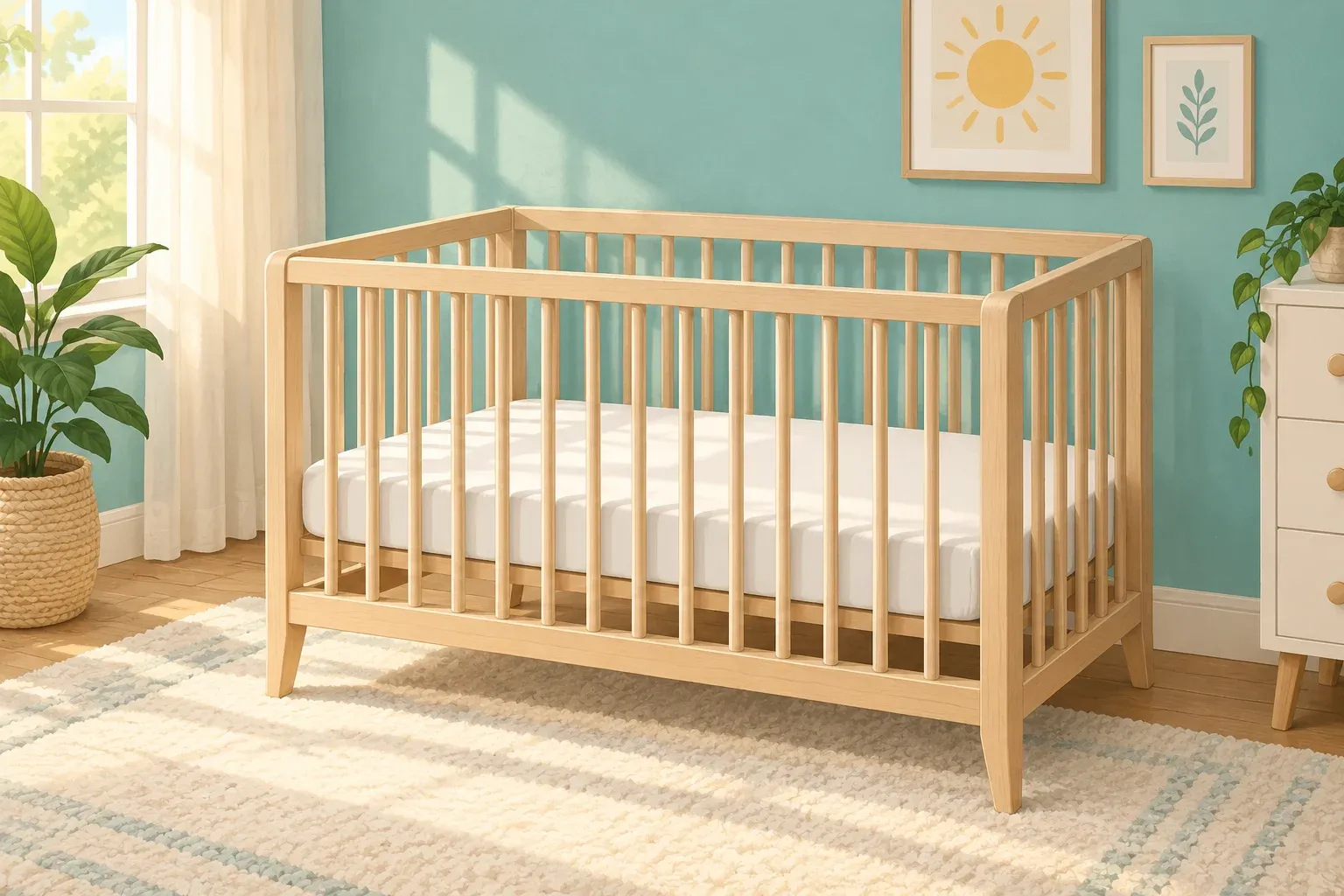
Both of these are the travel cribs we pick in our best pack and play guide: the Guava Lotus as the best all-round choice, the BabyBjörn Travel Crib Light as the best for travel. They share a lot. Each is a mesh-sided crib with its own thin mattress resting at floor level, each runs from newborn to about age 3, and each folds into a bag you can take on a plane. The differences are in how you carry it, how fast it goes up, how much floor it takes and what you can add for the newborn months.
This is a research-based comparison. We have not tested either crib hands-on; everything below comes from the makers’ US product pages, Guava’s setup guide, BabyBjörn’s US owner’s manual and federal safety sources, all checked on October 17, 2026.
Weight and fold: what you carry through the airport
BabyBjörn Travel Crib Light: 13 lb with its bag. BabyBjörn’s US manual lists the packed bag at 19 × 23.5 × 5.5 in. That’s a flat, slim package that slides behind a suitcase or into a car trunk gap, and it’s the lightest crib we compared for our guide.
Guava Lotus: 15 lb with its bag. Guava lists the packed size at 24 × 12 × 8 in. It’s longer and thicker than the BabyBjörn, but the bag converts to a backpack with padded straps, so you can carry it hands-free while you push a stroller or hold a baby. You can also carry it luggage-style.
What that means on a travel day:
- If every pound counts (a solo parent with a car seat, a stroller and a carry-on), the BabyBjörn’s 2 lb saving and slimmer bag are the clearer win.
- If free hands matter more than weight, the Lotus backpack is the more practical carry. BabyBjörn describes its bag as a carry or transport bag; we found no mention of backpack straps.
- Check your airline’s rules before you fly. Size limits and whether a travel crib flies free, as checked baggage or at the gate vary by airline and fare, and neither maker promises it fits as a carry-on.
Setup and take-down
BabyBjörn’s US manual describes setup in one clear movement: lift the crib out, hold the two short sides and unfold it so the legs swing down, check each leg is locked, then lay the mattress base-down and fasten four strap loops to hooks under the floor. There are no loose parts to attach.
Guava’s own setup guide for the Lotus has more steps: lock each leg in place, flip the frame and undo the clip, pull the top rail apart until it locks, then lay in the mattress and clip it at all four corners. It isn’t complicated, but it’s a few more motions at the end of a long travel day.
Both mattresses also pack around the folded frame inside the bag, so nothing gets left behind.
Footprint and floor height
Both cribs put the mattress on the floor, with no raised platform. That keeps them light, and Guava argues a floor-resting mattress also avoids the shake of a raised one. The trade-off is the same for both: you bend all the way down for every put-down and pick-up. Neither maker publishes an exact mattress height.
The sleep areas are almost the same size: Guava lists a 41.5 × 23.5 in mattress, and BabyBjörn’s manual lists 41 × 23.5 in. The frames differ more:
- BabyBjörn: about 44 in long and 24 in wide, with sides about 32 in tall (US manual). The narrower footprint suits a tight hotel room or the gap beside a bed.
- Guava Lotus: 45.5 in long, 31.5 in wide and 25.5 in tall (Guava). It takes more floor, but the lower sides mean a slightly shorter reach down.
The Lotus also has a zip side door that Guava says is lockable. Opened, it lets you sit beside your baby to settle them, and once your child crawls it turns the crib into a crawl-in play space. Our advice: zip and lock the door closed whenever your child is in the crib to sleep or you step away, and follow the warnings on your crib’s label. The BabyBjörn has no door.
Bassinet use and the newborn months
Neither crib comes with a raised bassinet.
- Guava sells a separate Lotus Bassinet kit for the same frame. Guava lists it for newborns up to 18 lb, or until your baby can push up on hands and knees or sit unassisted, and says it’s certified to the US bassinet standard (ASTM F2194). If you want a higher newborn sleep spot, use only Guava’s own kit made for the Lotus, set up as Guava directs.
- BabyBjörn lists no bassinet accessory for the Travel Crib Light on its US page. Newborns sleep on the floor-level mattress.
If you mainly want a raised newborn level at home, a play yard with a built-in bassinet may suit you better. Our guide to crib vs bassinet vs play yard explains the differences.
Age and height limits
Federal rules cover play yards for children who can’t climb out and are under 35 in tall, according to CPSC’s play yard guidance.
- BabyBjörn: the US product page says newborn to about age 3 or until your child can climb out, with no upper weight limit. The US owner’s manual is more specific: stop when your child can climb out or reaches 35 in.
- Guava Lotus: Guava says newborn to 3 or until your child can climb out, with no weight limit because the mattress rests on the floor.
Whichever you choose, stop at the first limit your child reaches, which can come before the third birthday.
On standards, Guava states the Lotus is certified to the US play yard standard (16 CFR 1221 / ASTM F406). BabyBjörn’s US page cites the European folding-crib standard (EN 716); its US manual carries play-yard-style warnings and the 35 in limit but doesn’t name a standard, so check the compliance label on the box.
Safe sleep in either crib
- Use only the mattress that came with the crib. BabyBjörn’s manual warns never to use the crib without its original mattress with the stiffened base, because a child could overturn it, and never to use more than one mattress.
- No add-on or aftermarket mattresses, toppers or pads. CPSC has warned that babies can suffocate in gaps between an undersized mattress or extra padding and the side walls, and play yard mattresses sold online have been recalled for exactly that.
- A fitted sheet made for that mattress, and nothing else. No pillows, blankets, bumpers or toys, in line with NIH’s Safe to Sleep advice. Always put your baby down on their back.
- Check the setup every time. All legs locked, rails locked, zips closed and the mattress flat and secured before your baby goes in.
Our guide to safe sleep for babies covers the rest, and the best pack and play guide explains why we only pick play yards that come with their own mattress.
Recall check
We searched CPSC’s recall database on October 17, 2026, by product name, manufacturer and recall title for Guava, Lotus, BabyBjörn, Baby Bjorn and Travel Crib. We found no recall for either the Guava Lotus Travel Crib or the BabyBjörn Travel Crib Light. The only Guava Family recall our searches returned was for its Roam stroller (November 2024), and the BabyBjörn-brand recalls returned were for a carrier (1999), feeding spoons (2006) and a bouncer (2009), none of them travel cribs.
A clean search on one date isn’t a guarantee. Check again with your exact model before each trip using our guide to checking baby product recalls.
Verdict
Pick the BabyBjörn Travel Crib Light if you fly a lot. It’s the lighter (13 lb) and slimmer (5.5 in folded) of the two, it opens in one movement, and its narrow footprint fits small rooms. You give up a door, a bassinet option and hands-free carrying.
Pick the Guava Lotus if one crib has to do double duty at home and away. The backpack carry, the zip side door for settling and play, and the optional bassinet kit make it more versatile. You carry 2 lb more, set up a few more steps and need more floor space.
Neither is a raised newborn sleeper out of the box, and neither replaces a full-size crib for everyday nursery use if you have the room.
Who should choose which
Choose the BabyBjörn if you:
- Fly several times a year and want the lightest, slimmest bag
- Want the fastest setup after a long travel day
- Often stay in hotel rooms or small guest rooms
- Don’t need a bassinet level
Choose the Guava Lotus if you:
- Want one crib for naps at home, grandparents’ visits and trips
- Carry gear through airports alone and want both hands free
- Like the idea of a side door to settle your baby or make a play space
- Want the option of a raised newborn bassinet from the same maker
Look elsewhere if you want a built-in bassinet and changer for daily use at home. A heavier play yard with those features suits a home base better; see the other picks in our best pack and play guide and the nursery and sleep hub.
Frequently asked questions
Which is lighter, the Guava Lotus or the BabyBjörn Travel Crib Light?
The BabyBjörn, at 13 lb with its bag against 15 lb for the Lotus, according to each maker. The BabyBjörn also packs flatter: 5.5 in thick against 8 in.
What is the lightest travel crib for flying?
Of the travel cribs we compared for our pack and play guide, the BabyBjörn Travel Crib Light is the lightest, at 13 lb with its bag. Weight is only part of it: also check the folded size, how you carry it, and that it comes with its own mattress so you never need to buy an add-on.
Can a newborn sleep in either crib?
Yes. Both makers rate their cribs from newborn, and each uses its own flat mattress at floor level. NIH’s Safe to Sleep advice is a firm, flat, level surface with only a fitted sheet. If you’d rather not bend to the floor, Guava sells a Lotus Bassinet kit for newborns up to 18 lb or until they push up on hands and knees or sit; BabyBjörn lists no bassinet for the Travel Crib Light.
When does my child outgrow these travel cribs?
Stop when your child can climb out or, for the BabyBjörn, reaches 35 in tall, per its US manual. Both makers say about age 3, but your child may reach the height limit or start climbing out sooner.
Can I add a thicker mattress to make them more comfortable?
No. Use only the mattress each crib came with. BabyBjörn’s manual warns against using the crib without its original mattress and base or with more than one mattress, and CPSC warns that add-on mattresses can leave gaps where babies can suffocate.