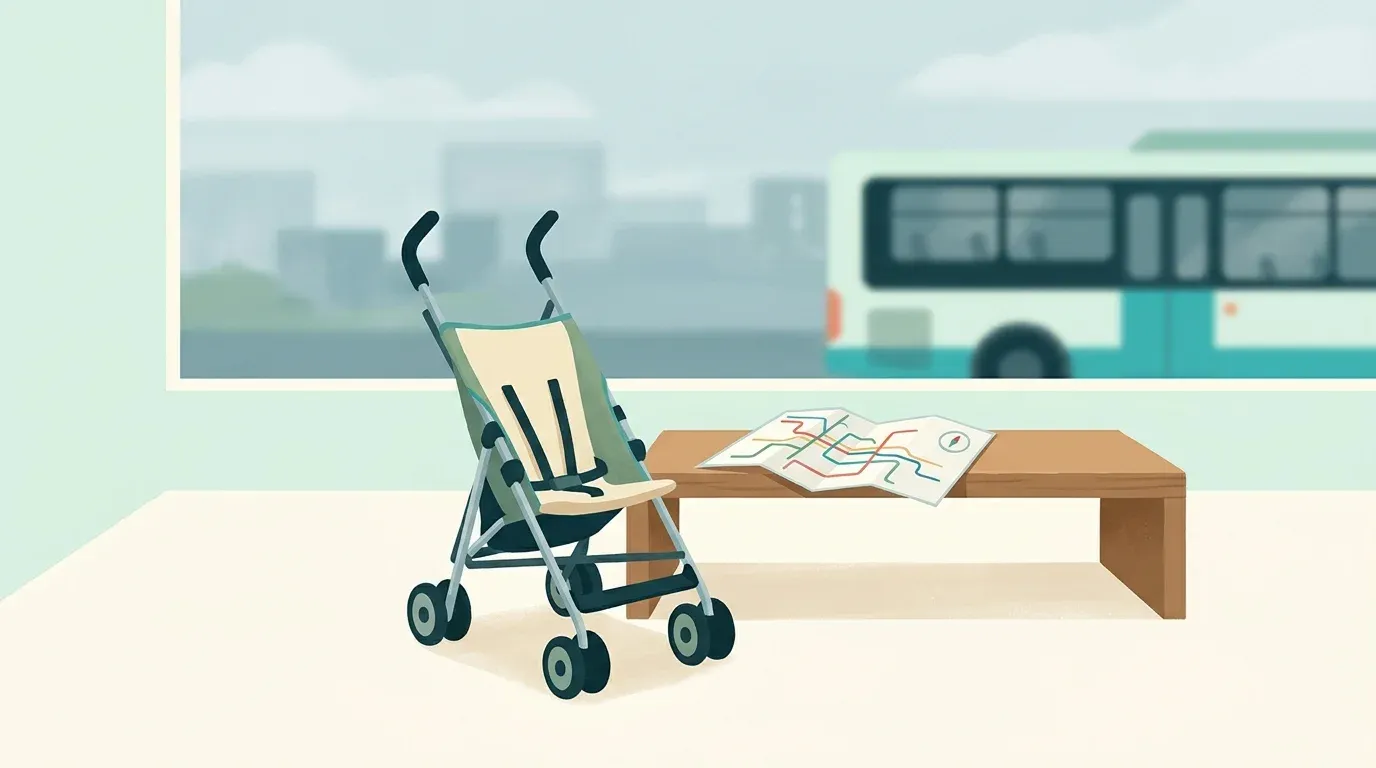
Before taking a stroller on a bus or train, answer three questions: can it stay open on this service, where can it go, and how will you reach the boarding point? Plan the whole journey, including transfers and the return trip, before deciding that a route works for you.
This is a trip-planning guide for equipment you already have. For broader equipment decisions, see our stroller buying guide. For flights and overnight arrangements, use the separate baby travel gear checklist.
Check the service, not just the city
Find the operator’s own stroller policy and match it to each vehicle you expect to use. Write down whether folding may be required and whether the guidance identifies a particular boarding door or stroller area. If it does not cover your service, ask the operator before travelling.
These US examples show why a single rule is not enough. They were checked on 22 October 2026; recheck the linked guidance for your trip.
| Service | What the official guidance says | What to establish for your journey |
|---|---|---|
| New York City MTA local and Select Bus Service buses | Many have a designated open-stroller area near the rear door. Folding is still required if the stroller does not fit or another stroller occupies the area. | Whether the arriving bus has the space, plus your plan if it is unavailable. |
| San Francisco Muni | Cable cars require the stroller to be folded and the child removed before boarding. Other Muni vehicles permit open strollers when space allows, subject to the stated conditions. | Which vehicle operates each leg; permission on one service does not answer the question for another. |
| Washington-area Metrobus | Its March 2023 announcement permits open strollers, with conditions for placement and control. The operator can require moving or folding one for passenger safety. | Where to position it and what you will do if asked to move or fold. |
Sources: MTA bus guide, Muni young-children guidance, and Metrobus policy announcement. These are local examples, not a nationwide policy or a promise of space on a particular departure.
Map the path from street to platform
Our suggested route note includes the exact entrance, transfer path and exit you intend to use. Look for the operator’s accessibility information and current elevator notices; do not leave an unanswered access question until you reach the station. Confirm the return direction separately rather than assuming it uses the same path.
For its system, WMATA tells passengers with a child in a stroller to use the elevator instead of an escalator. It also says to wait for the next elevator if it is full and to keep clear of closing doors. Do not use a stroller to hold a door open.
If your planned step-free route is unavailable, stop and ask staff about an alternative. Our planning suggestion is to identify another accessible route before departure, rather than improvise how to carry an occupied stroller on stairs. An accessibility symbol is a starting point for checking the actual journey, not our assurance that every entrance or transfer will work.
Know the onboard conditions
Permission to board with an open stroller comes with conditions. Muni requires it to remain under the owner’s control with the wheel brake set, without obstructing the aisle or passengers, and outside the securement area. Its operator may require folding when the vehicle is full or the stroller interferes with passengers.
Metrobus directs stroller users to the priority seating area, with brakes locked during movement and the stroller held throughout. Aisles and doorways must remain clear. Seniors and people with disabilities retain first priority there.
The distinction matters: Muni’s restriction on the securement area and Metrobus’s instructions for priority seating are specific to those systems. Do not transfer one agency’s placement instructions to another vehicle. Ask the operator where to go if the signs or layout are unclear, and follow the applicable instructions.
Make a folding contingency before leaving
Treat folding as a possibility to plan for, not something to work out at the vehicle door. Using your stroller’s own instructions, review its folding and carrying procedure ahead of time. This guide does not establish a folding technique or an age or weight limit for your equipment.
Our suggested questions are:
- If folding is required, can the accompanying adult or adults manage the child, stroller and bags according to the applicable instructions?
- Where will loose belongings go during that change?
- Would waiting for another service solve the problem, or would you need a different route?
- Who can you contact if the return journey becomes impractical?
If you cannot answer those questions comfortably, revise the journey before setting off. Do not assume the operator or another passenger will be available to carry equipment for you.
Save a short journey note
| Journey detail | Your confirmed answer |
|---|---|
| Outbound and return services | Operator and vehicle type for each leg |
| Open or folded | Rule, conditions and link to the official page |
| Boarding and onboard space | Door or area, where specified |
| Station access | Planned entrance, transfer and exit |
| Disruption check | Where to check service and elevator notices |
| Backup | Alternative route or decision to postpone |
Keep unanswered items visible. The aim is a workable route and a manageable contingency, rather than the shortest journey shown on a map.
How we prepared this guide
This is a research-based guide to travel logistics, using the official agency pages listed above. We have not tested these routes or strollers hands-on, and we have not checked real-time conditions for your departure. The worksheet and contingency questions are our editorial planning suggestions. Consult the operator’s current guidance and your equipment instructions; this article does not certify a route, boarding arrangement or stroller as suitable.