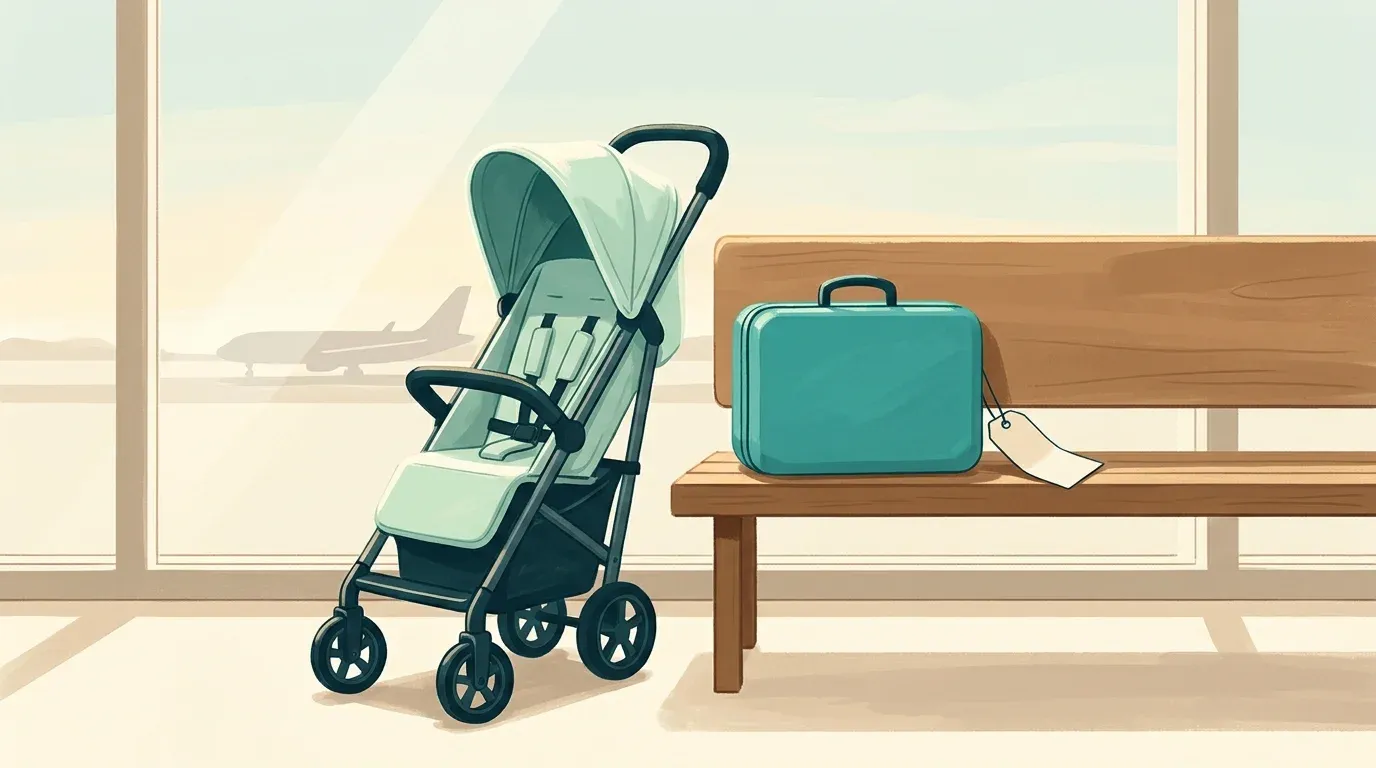
Before taking a stroller to the airport, decide where you expect to hand it over and where you expect it back. Those are two separate questions. A plan that ends with “gate-check it” still leaves the arrival walk and any connection unresolved.
This guide focuses on the airport handover, rather than choosing a new stroller or packing for the whole trip. Use it alongside our baby travel gear checklist. The airline examples below were checked on October 26, 2026; confirm the arrangements for every flight on your actual itinerary.
Confirm the handover before leaving home
Start with the airline operating each flight. Give it your stroller’s folded measurements, weight and configuration from the matching manufacturer documentation. Ask which pieces will be handled together and which need separate tags. Do not treat a shop’s “cabin-sized” description as permission to bring it aboard.
Two current airline pages illustrate why the details matter:
- American Airlines allows a ticketed customer travelling with a child or to adopt to check one stroller and one car seat free. Both can go at the counter, or one at the gate and one at the counter. Its page directs non-collapsible strollers and stroller wagons without built-in child safety straps to the counter; other strollers should be checked at the gate.
- Delta says strollers and child-restraint seats can be checked without a fee, do not count toward the baggage allowance, and can be checked before security or at the gate. It separately treats wagons as checked baggage rather than including them in that stroller statement.
These are dated examples, not a promise about another carrier, a partner flight or your booking. If you are also taking a car seat, confirm its handling separately. This article does not assess aircraft seating or restraint use.
Write the agreed answer into a short note:
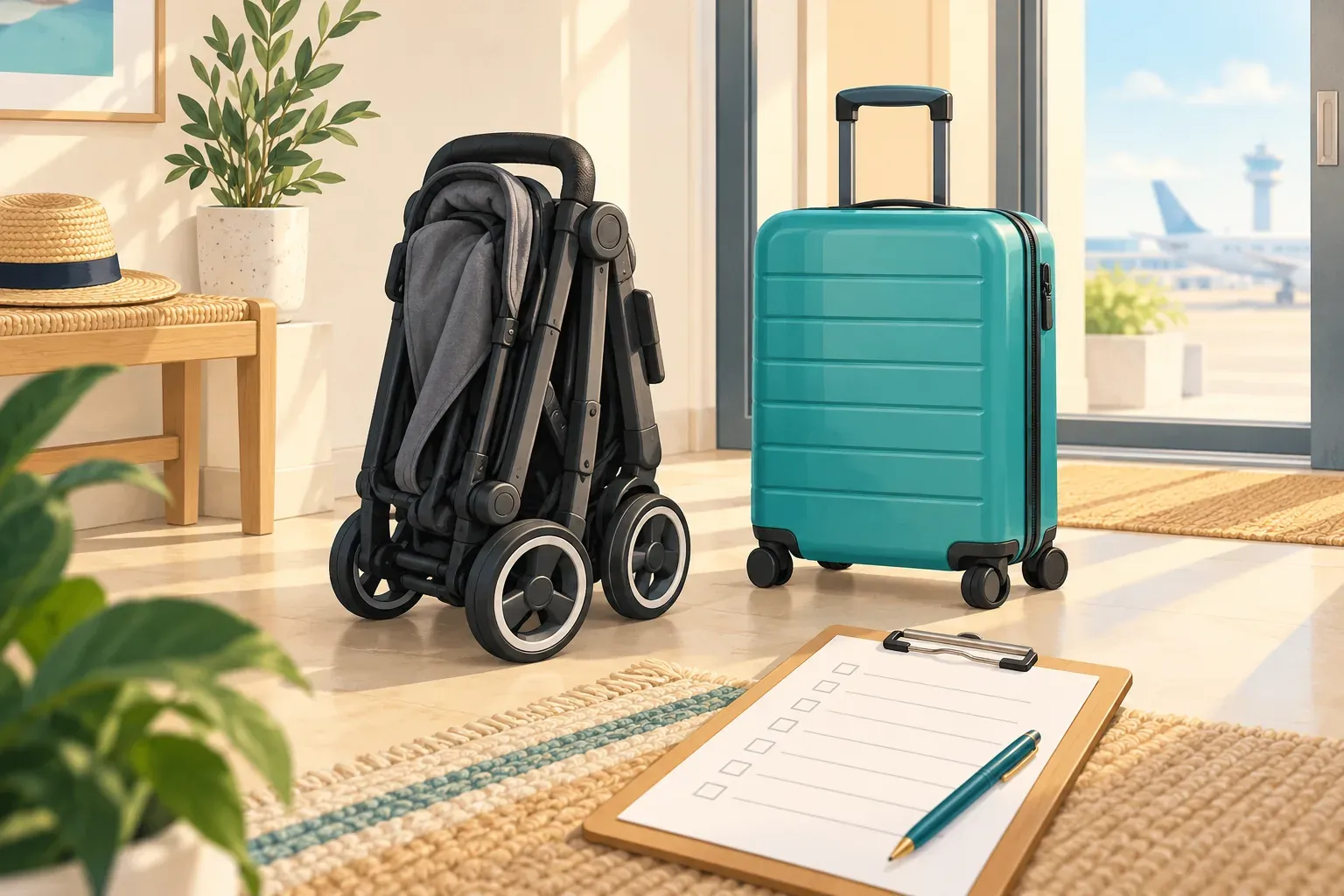
Copy these prompts once for each flight, including the return journey:
- Flight and operator: record who is flying this leg.
- Handover: note counter or gate, as confirmed, and any separately tagged pieces.
- Collection: record exactly where the airline says it will return the stroller.
- Connection access: confirm whether you will have it between flights.
- Unresolved question: name the answer you still need and who can provide it.
These prompts are our planning tool, not an airline baggage label. Revisit the note after a carrier or itinerary change.
Rehearse the empty-stroller transition
At home, practise the manufacturer’s folding and unfolding sequence with the stroller unoccupied. Work out where your phone, travel documents and loose belongings will go when the stroller is folded. Avoid making its basket the only place you can carry essentials that you need after handover.
If two adults are travelling, agree who stays with the child and who handles the equipment. If you are travelling alone, identify the moment when you will need assistance rather than planning to manage every item at once. This is an organisational rehearsal, not a reason to improvise a different carrying position or equipment attachment. Our stroller selection guide explains everyday carrying and folding trade-offs if you are still deciding what to take.
Prepare for security as a separate handover
In the FAA’s May 2023 interview with TSA representatives, the speakers explain that children must be removed from strollers for screening. Equipment goes through X-ray screening or, if too large, a visual and physical inspection. They encourage families to communicate with officers and ask for help with folding or loading equipment.
Use that explanation to prepare, then follow the officers’ instructions at the checkpoint. It is background from a dated official interview, not a guarantee of a particular lane procedure on your travel day. Ask before trying to force equipment into a scanner or dismantling unfamiliar parts.
Keep the screening plan distinct from the airline plan: getting through security does not establish where the stroller will travel on the aircraft or where it will be returned.
Ask the collection question when the tag is issued
Before handing the stroller over, ask the agent to confirm these details in plain language:
- Where exactly do we leave it, and when should it be folded?
- Which pieces are included in this tag?
- Where will we collect it after this flight?
- If we connect, will it be available between flights or sent onward?
- Who should we ask if it is not at the stated collection point?
Keep any claim receipt the airline gives you somewhere accessible, rather than in a bag being checked. Note the answer for each leg instead of assuming that the outbound arrangement applies all the way home. A photograph of your equipment and its identifying details can help you explain which item you are looking for; keep personal travel information private.
Plan the gap after landing
Imagine the interval between leaving your seat and reaching the confirmed stroller collection point. Decide how the accompanying adults will manage the child and remaining bags during that gap. If your plan depends on immediate access to the stroller, resolve the collection question with the airline before departure.
At collection, take time to identify your item and account for its pieces. If it is missing or appears damaged, ask airline staff about the reporting process and what to do next. Do not assume this checklist establishes compensation rights or that equipment is fit to use. Questions about damage, missing parts or operation belong with the manufacturer and airline as appropriate.
The useful end result is one short record: where it leaves you, where it returns, and what you will do in between. Save it with your booking so another accompanying adult can find it too.
How we prepared this guide
This is a research-based guide by the Fresh Baby Gear Team. We opened the airline policy pages and the FAA interview on October 26, 2026. We have not tested strollers or checked an individual flight arrangement. The handover worksheet and preparation prompts are our original editorial tools. There are no individual product recommendations or affiliate offers. Check current instructions with the operating airline and airport; screening and handling outside the United States may differ.